Sunday, March 28, 2010
Blog Post #52

Blog Post #51
Blog Post #50
Blog Post #49
Blog Post #48
Blog Post #47
Blog Post #46
Blog Post #45
Blog Post #44
Blog Post #43
Blog Post #42
Blog Post #41
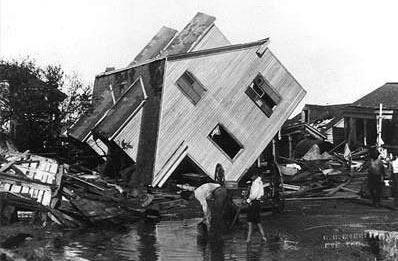
The 1900 hurricane in Galveston was a devastating disaster, and we were definitely not prepared for it.
Those who managed, either by sheer luck or the grace of God, to survive the storm faced the challenge of moving forward.
In his memoirs, meteorologist Isaac Cline referred to the morning after the storm as "a most beautiful day."
It was indeed a sunny, warm day, the kind of day people came to Galveston for at the turn of the century. But few visitors would walk the sandy shores for months after the infamous hurricane.
Instead, bodies of the dead that were improperly buried at sea washed ashore on those beaches, leaving even more treacherous work for the cleanup crews.
The storm left behind a legacy that extends across the country. As families moved from the island, they carried with them the story of that night.
Blog Post #40
Wednesday, March 17, 2010
Blog Post #39
Blog Post #38
Blog Post #37
Blog Post # 36
Blog Post #35
Blog Post #34
Blog Post #33
Sunday, March 7, 2010
Blog Post #32
Saturday, March 6, 2010
Blog Post # 31
Blog Post #30
Blog Post #29
Blog Post #28
Blog Post #27

MountainView.JPG
Saturday, February 27, 2010
Blog Post #26
Blog Post #25

Friday, February 26, 2010
Blog Post #24
Blog Post #23
Blog Post #22
Blog Post #21
Sunday, February 21, 2010
Blog Post #20
Blog Post #19
Blog Post #18
Blog Post #17
Wednesday, February 10, 2010
Blog Post #16
Blog Post #15
Tuesday, February 9, 2010
Blog Post #14 B
Blog Post #14 A
Monday, February 8, 2010
Blog Post #13
Blog Post #12
Thursday, February 4, 2010
Blog Post #11
Blog Post #10
It is interesting to note that whitewater rafting was one of the earliest forms of transportation. It was not only used for carrying people but also for transferring goods from one place to another. However, it became quite popular as a form of leisure activity in the 1980s.
In 1811, the first recorded attempt to navigate the Snake River in Wyoming was planned by the Overland Astorians. While attempting to boat the stretch below Jackson Hole, the river was found to be too treacherous and it came to be called ?Mad River.?
The rubber river raft is believed to have been invented in the early 1840s. It was first made by Lt. John Fremont, who was then serving in the U.S army and Horace H. Day. They invented the rubber raft with the intention of surveying the Rocky Mountains and the Great Plains. Although the raft was invented in the mid-nineteenth century, it was not until the turn of the century that the first ever commercial whitewater trip was undertaken. At first, surplus military rafts were used as boats and it was only much later that inflatable rafts were used.
http://ezinearticles.com/?History-of-Whitewater-Rafting&id=276992
Wednesday, February 3, 2010
Blog Post #9
Blog Post #8
Tuesday, February 2, 2010
Blog Post #7
Friday, January 29, 2010
Blog Post #6
Blog Post #5
Modern bungee jumping as we know it today actually started on the 1st of April ( Fools' Day ) 1979 when group of people from the Oxford University Dangerous Sport Club, impressed by a film about "vine jumpers", jumped from 245-Clifton Suspension Bridge in Bristol, England. Using nylon braided, rubber shock cord instead of vines, and dressed in their customary top hat and tails, they performed a four man simultaneous jump .The enthysiasts promptly were arrested for this. But at least hit the world press the next day. The new adrenaline mania has been started. The D.S.C. performed many other jumps, including one off the Golden Gate Bridge. In early 1988, A.J. Hackett and Chris Allum, opened the first commercial jump site in Ohakune, New Zealand. Hackett also made a great commercial show in 1987 when he jumped from the Eiffel Tower in Paris.
Blog Post #4
Thursday, January 28, 2010
Blog Post #3
Blog Post #2
Blog Post #1


